How to
Which AI bots should you let into your website? A checklist
By Shubham Gururani, Founder, Opal AEO
Published · Facts checked · 4 min read
The short answer
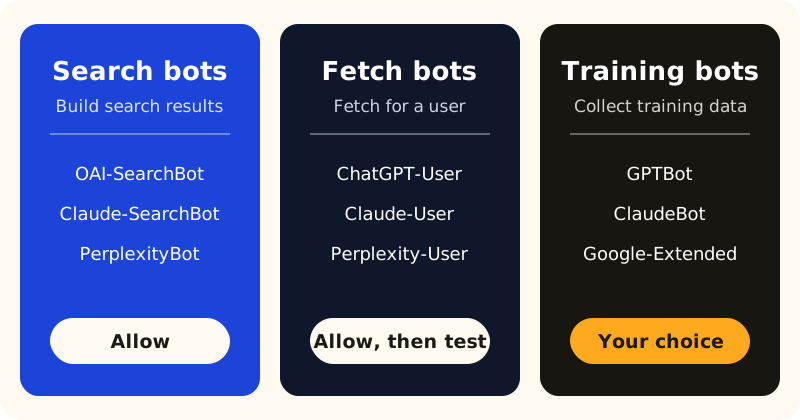
Three kinds of AI bot visit a website: search bots that build the index an assistant searches, fetch bots that open a page when a user asks, and training bots that collect data for models. Allow the first two if you want to be named in AI answers, and decide about the third separately. Blocking a search bot can keep your pages out of that assistant's answers.
The short version
- Treat AI bots as three groups, not one.
- Allow search bots and fetch bots if you want AI assistants to read your pages.
- Training bots are your choice, and blocking them does not hide you from AI search.
- robots.txt is not the only gate: a firewall or CDN can block bots that robots.txt allows.
What are the three kinds of AI bot?
The three kinds are search bots, fetch bots and training bots, and each AI company runs its own version of each. The company's own documentation is the only reliable list, because names change and third-party lists go out of date.
| Kind | What it does | Examples from the companies' pages | Does robots.txt control it? |
|---|---|---|---|
| Search bots | Build the index an assistant searches | OAI-SearchBot, Claude-SearchBot, PerplexityBot | Yes, according to each company |
| Fetch bots | Open a page when a user asks about it | ChatGPT-User, Claude-User, Perplexity-User | Depends on the company (see below) |
| Training bots | Collect content that may train models | GPTBot, ClaudeBot, Google-Extended | Yes, according to each company |
Which bots decide whether you appear in AI answers?
The search bots and the fetch bots decide it, because they are the ones that read your pages for an answer. OpenAI says that a site which opts out of OAI-SearchBot will not appear in ChatGPT search answers, though it can still show up as a navigational link. Anthropic says that blocking Claude-SearchBot stops a site's content being indexed for search and may reduce its visibility, and that blocking Claude-User may reduce visibility in user-directed web search.
Perplexity describes PerplexityBot as the bot that surfaces and links websites in its search results, and recommends allowing it in robots.txt so your site can appear.
Google works differently. Google says its AI features need no special markup or files: a page must be indexed and able to show a snippet in Google Search. Googlebot is the bot that crawls for Search.
What about the training bots?
Training bots are your choice, and blocking them is separate from being found. OpenAI says GPTBot and OAI-SearchBot can be controlled independently, so you can disallow GPTBot and still allow the search bot.
Google-Extended needs care. Google's crawler page says it is a robots.txt token, not a separate crawler, and that it controls whether crawled content may be used to train future Gemini models and also whether it may be used for grounding in the Gemini apps. It says Google-Extended does not affect inclusion in Google Search. So blocking it is not only a training decision.
Why is robots.txt not enough?
robots.txt is a request, and two other things can override it. The first is the bot itself: OpenAI says robots.txt rules may not apply to ChatGPT-User because users start those visits, and Perplexity says Perplexity-User generally ignores robots.txt for the same reason. The second is your own security setup. Services such as Cloudflare's AI Crawl Control let a site owner set allow or block rules for individual crawlers, so a bot that robots.txt allows can still be blocked by a rule set there.
The only way to know a bot really gets through is to visit as that bot and see what comes back. Two cautions from the companies. Anthropic says blocking its IP addresses may not work as an opt-out, because it prevents its bots from reading robots.txt. Perplexity says that if you use a firewall, you should match its bots' user agent together with their published IP ranges.
What does a sensible robots.txt look like?
A sensible robots.txt names each bot you care about, allows the search bots, and disallows only the training bots you want to keep out. This example is for illustration only, so check each company's page for the current names before you copy it.
# Let AI search bots in
User-agent: OAI-SearchBot
Allow: /

User-agent: Claude-SearchBot
Allow: /

User-agent: PerplexityBot
Allow: /

# Keep two training bots out (your choice)
User-agent: GPTBot
Disallow: /

User-agent: ClaudeBot
Disallow: /
Anthropic says a rule must be added on each subdomain separately. OpenAI says changes to robots.txt can take about 24 hours to take effect for search.
What to do this week
- Open your robots.txt file and list every bot it names. Check each name against the company's own page.
- Decide which of the three groups you want to allow, and write the rules down in one sentence each.
- Look at your CDN and firewall settings for AI bots, and confirm they match your robots.txt.
- Visit your homepage as each search and fetch bot, or run the free AI bot checker, and note any bot that gets a block page.
- Put a date in your calendar to repeat the check in three months.
Frequently asked questions
Will blocking GPTBot keep my brand out of ChatGPT answers?
No. OpenAI says GPTBot, which collects training data, and OAI-SearchBot, which surfaces sites in ChatGPT search, are controlled separately. A site that opts out of the search bot will not appear in ChatGPT search answers, apart from navigational links.
Does Google-Extended control AI Overviews?
Google's pages do not say so. They say Google-Extended limits training and grounding for Gemini, and that AI Overviews and AI Mode need no special markup: a page must be indexed and able to show a snippet. Ordinary Search controls such as Googlebot and nosnippet apply there.
Should I block the bots that fetch a page when a user asks?
Only if you accept the cost. Anthropic says blocking Claude-User stops retrieval for users' questions and may reduce your visibility. OpenAI and Perplexity say their user bots may not follow robots.txt at all, so a robots.txt rule may not hold, and a firewall rule is the stronger control.
How often should I check my settings?
After every change to robots.txt, your CDN or your security tools, and once a quarter even if nothing changed. The companies add and rename bots, so read their own pages again each time.
Sources
Every figure and claim above comes from one of these pages. We opened each one on the day shown above.
- Overview of OpenAI crawlers, OpenAI
- Does Anthropic crawl data from the web, and how can site owners block the crawler?, Anthropic
- Perplexity crawlers, Perplexity
- Google's common crawlers, Google Search Central
- AI features and your website, Google Search Central
- AI Crawl Control, Cloudflare, 14 August 2026
About the author
Shubham Gururani
Founder, Opal AEO
Shubham Gururani is the founder of Opal AEO. He has been in Bitcoin since 2015 and has worked in web3 since 2021. Before that he spent years at Airtel selling data centre, security and network services to businesses. Since 2021 he has been an independent full-time trader of crypto and the stock market, and he has been learning and building with AI. He started Opal AEO to show businesses what AI assistants say about them when customers ask what to buy.
About Opal AEO
About Opal AEO
Opal AEO shows how often AI assistants name your brand when people ask buying questions, what they say about it, and which websites they rely on. It is made for any brand that people research with an AI assistant before they buy.
This post was drafted with the help of AI, then checked against its sources and approved by a person before it was published. Nobody can promise how an AI assistant will answer, so nothing here is a guarantee.
More from the blog