This week
What changed in AI search, 30 October to 5 November 2026
By Shubham Gururani, Founder, Opal AEO
Published · Facts checked · 3 min read
The short answer
Between 30 October and 5 November 2026, Google said it plans to support a shared robots.txt control for AI training in 2027, and three new research papers tested how well tactics for being named by AI hold up. The common lesson is that AI answers vary, so you should measure across many questions and keep your own access rules explicit.
The short version
- Google plans one shared AI training control in robots.txt for 2027. Your current rules stay as they are.
- A new study found that assistants often disagree about which product comes first.
- Researchers showed how a planted brand mention can steer AI search, so checking what AI says about you matters.
- Gains from GEO methods depend on the intent of the question.
What did Google say about AI training controls?
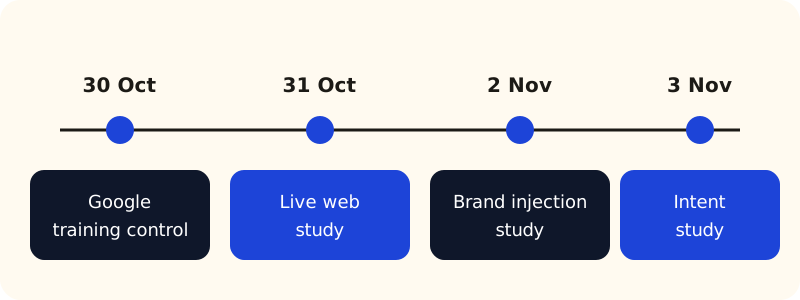
Google said on 30 October 2026 that it plans to support a shared AI training control in robots.txt. Google's post says the control is based on a draft from the IETF's AIPREF working group, lets a site set its training preference for several AI providers in one step, and that Google aims to support it in 2027.
It does not replace what exists today. Google says company-specific controls keep working, robots.txt stays the mechanism, and Google-Extended is not replaced. If a site opts out of training with the shared signal and says nothing about Google-Extended, Google says it will treat the site as if Google-Extended were disallowed. Sites that explicitly allow Google-Extended can still appear in Gemini apps grounding responses.
What to do: keep a deliberate Google-Extended line in your robots.txt, and read our guide on which AI bots to let in before you change anything.
Do tactics for being named by AI hold up on the live web?
They hold up less steadily than single tests suggest. A paper posted to arXiv on 31 October 2026, the LIVE-GEO study, rewrote the product descriptions of 80 made-up brands five different ways, published them as real web pages and asked three assistants (ChatGPT, Gemini and Grok) to pick a top product.
In the paper's results, the assistants chose the same top product for only 48.8% to 66.3% of the brands. In ChatGPT, one rewrite came first in 73.8% of tests when the candidate pages were listed in one order and 93.8% when they were listed in the opposite order. The authors' own check for faithful numbers also flagged all 80 rewrites made by adding statistics.
This is a preprint on made-up brands, not proof about your market. What to do: never judge visibility from one answer, and never add a number to a page that you cannot source.
Can a planted mention steer AI search?
Researchers say it can in a lab setting, which is a reason to watch what AI says about you. A paper posted on 2 November 2026, the brand injection study, describes a method that adds one brand mention to an existing article so that a generative search system is more likely to retrieve it and mention the brand. On a test of 1,000 articles and 60 synthetic brands, the method reached 82.2% on the paper's Hit@10 retrieval measure and a brand mention rate of up to 62.7%.
The authors conclude that defenses against this kind of manipulation are needed. What to do: check which websites AI cites when it talks about your brand, correct what is wrong at its source, and never plant mentions yourself.
Does the question's intent change what wins?
It does in this study. A paper posted on 3 November 2026, IntentGEO, argues that one product description serves people with different needs and at different stages of a decision, so its visibility depends on the question being asked. The authors found that the gains of existing GEO methods varied by intent.
What to do: write separate pages for separate needs, such as a how-to for people learning and a comparison for people choosing, and track your visibility by the kind of question, not only in total.
What to do this week
- Open your robots.txt and make sure your Google-Extended line is there on purpose.
- Pick 10 questions a buyer would ask an AI assistant and ask each one three times, then write down how often your brand is named.
- Check each statistic on your key pages has a visible source.
- Search for your brand in AI answers and note which websites they cite for it.
Frequently asked questions
Does the shared training control replace Google-Extended?
No. Google says company-specific controls keep working next to the shared signal, and that robots.txt stays the mechanism. It aims to support the shared control in 2027, so nothing changes in your robots.txt today.
Do these studies prove that GEO tactics work?
No. All three are papers posted to arXiv that have not been through peer review, and they test made-up or synthetic brands in lab setups. Treat them as signals about what to measure, not as proof of what works on the live assistants you care about.
Should I add statistics to my pages to be named more often?
Only real ones, each with a source. In the LIVE-GEO study, the authors' own check for faithful numbers flagged every one of the 80 rewrites made by adding statistics.
Sources
Every figure and claim above comes from one of these pages. We opened each one on the day shown above.
- Supporting a shared AI training control for websites, Google Search Central, 30 October 2026
- Do GEO Gains Survive the Live Web? Evaluating In-the-Wild Visibility Gains of Generative Engine Optimization via LIVE-GEO, arXiv, 31 October 2026
- Characterizing Adversarial GEO via Implicit Brand Injection, arXiv, 2 November 2026
- IntentGEO: Intent-aware Generative Engine Optimization for Recommendation, arXiv, 3 November 2026
About the author
Shubham Gururani
Founder, Opal AEO
Shubham Gururani is the founder of Opal AEO. He has been in Bitcoin since 2015 and has worked in web3 since 2021. Before that he spent years at Airtel selling data centre, security and network services to businesses. Since 2021 he has been an independent full-time trader of crypto and the stock market, and he has been learning and building with AI. He started Opal AEO to show businesses what AI assistants say about them when customers ask what to buy.
About Opal AEO
About Opal AEO
Opal AEO shows how often AI assistants name your brand when people ask buying questions, what they say about it, and which websites they rely on. It is made for any brand that people research with an AI assistant before they buy.
This post was drafted with the help of AI, then checked against its sources and approved by a person before it was published. Nobody can promise how an AI assistant will answer, so nothing here is a guarantee.
More from the blog